
Welcome
LLM Persuasion Safety Hub is a curated collection of datasets, benchmarks, and automated evaluation tools for studying persuasive capabilities in large language models (LLMs). The goal is to bring together the most relevant resources as they emerge, helping researchers navigate this rapidly evolving field.
What is included
The hub covers research papers, datasets, and codebases relevant to LLM persuasiveness evaluation.
Associated paper
This resource hub is a companion to a review paper on automated methods for evaluating LLM persuasiveness.
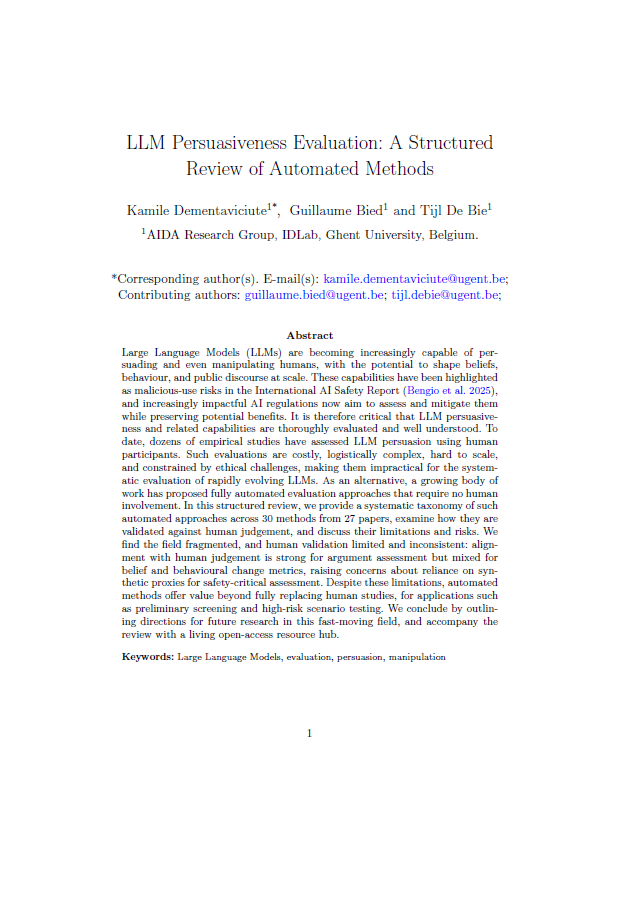
LLM Persuasiveness Evaluation: A Structured Review of Automated Methods
Dementaviciute, K. · Bied, G. C. M. · De Bie, T.
- Accepted to the AIMII Workshop at IASEAI, February 2026, Paris, France (poster, non-archival)
- Accepted to the AI4GOOD Workshop at ICML, July 2026, Seoul, South Korea (poster, non-archival)
- Currently under review as a journal publication
Taxonomy
Our review paper organises automated evaluation methods into the following taxonomy, with each
method's category shown in the resources table.
Note: the table only includes entries for covered papers with an associated
resource, alongside papers that provide a relevant resource, but were not covered in the review.
Persuasion Evaluation
Persuasiveness
Methods
Simulations
Simulations
Methods
Methods
Scoring Models
Persuasiveness
Cite this work
If you use this website for research, please cite our preprint:
@misc{dementaviciute_2026,
  author       = {Dementaviciute, Kamile and Bied, Guillaume and De Bie, Tijl},
  title        = {LLM Persuasiveness Evaluation: A Structured Review of Automated Methods},
  month        = jun,
  year         = 2026,
  publisher    = {Zenodo},
  doi          = {10.5281/zenodo.20703534},
  url          = {https://doi.org/10.5281/zenodo.20703534},
}
How to contribute
If you know of a relevant resource that is missing, there are two ways to add it:
- Contact us — email us the resource information, details in the Contact page.
- GitHub — add it to the website's GitHub repository and raise a pull request.